
By Brian Rokos | brokos@scng.com | The Press-Enterprise
PUBLISHED: March 18, 2026 at 3:44 PM PDT | UPDATED: March 20, 2026 at 2:58 PM PDT
For police and firefighters, K-9s are indispensable tools.
The dogs’ intimidating presence can prompt even the most hardened criminals to throw up their hands.
The sense of smell in other canines can detect illegal drugs, or electronics that store child pornography. For firefighter investigators, K-9s can sniff out liquids that ignite blazes.
They can nose their handlers to dead bodies, missing people, prohibited agriculture at customs checkpoints, and explosives — even in the tiniest quantities.
But, their handlers say, K-9s are much more than handcuffs or axes.
“People outside may say, ‘Well, it’s just property,’ ” said Los Angeles police Officer Maricela Corral, who for six years has worked with K-9 Dart. “We train with them every day, we live with them. We feed them. I take care of him when he has diarrhea, you know?
“They’re more than partners,” Corral continued. “You’re together all day, every day. So you just get used to having that little furball with you. …
“They keep us safe. They keep the community safe.”
For 150-plus years, they have been at the sides of cops and firefighters, protecting and detecting.
“Their ability to smell is about 100,000 to a million times better than ours,” said Dave Reaver, the president of Adlerhorst International in Jurupa Valley, a leading trainer of K-9s. “What drives these dogs to find narcotics, electronics, explosives is the hope that they get a toy at the end.”
Or a tasty treat.
“If I say, ‘You’re going to get this toy, but I need you to find these certain target odors’ … no matter what environment we’re in, a good dog will do that,” Reaver said.
Numerous breeds make good K-9s: bloodhounds, Labrador retrievers, springer spaniels, Dutch shepherds, Belgian Malinois, beagles and German shepherds. They largely come from specialty breeders and trainers in Europe. Commands are often given in Czech, Dutch, Hungarian, German or French.
“These dogs have certain characteristics and drives that separate them from the dogs we had growing up,” Reaver said. “All they want to do is work. That is fun for them.”
K-9s and badges
A lot of police K-9s wear badges around their necks, but they are not sworn peace officers.
“They can’t literally take an oath,” said Sgt. Matt Sutter, an Anaheim Police Department spokesman.
Assaulting a police dog can land the aggressor in state prison for up to three years, though.
There are an estimated 50,000 working K-9s in the United States. Many Southern California agencies have K-9s trained in both apprehending bad guys and detection.
Others are specialists.
The Orange County Sheriff’s Department has 33 K-9s — four of them are jail dogs that detect drugs, with two of those able to sniff out contraband cellphones.
K-9s jump into spaces unsafe for officers or where the cops can’t see.
Late last year, a domestic-violence suspect holed up in a bedroom. San Bernardino police opened the door and sent in Timur, and the K-9 rousted the suspect, who was safely arrested.
Several months prior, after Westminster police chased down a man who had run from his car, bloodhound Creed retraced the suspect’s path and found a backpack with a loaded handgun stashed in a bush.
On a rainy November 2025 day at Adlerhorst, Reaver put aspiring apprehension dogs, trained to chase down suspects, and their handlers and other cops who played “agitators” through the paces.
The agitators attract the dogs’ attention and get them to bite protective clothing. In another drill, an officer hides behind a box and when discovered by the dog, he runs and is immediately knocked down.
Pierson Loska, 28, a Newport Beach patrol officer, wants to join his department’s K-9 team, which has two apprehension dogs.
“Having a K-9 on the scene with you, especially just hearing that loud bark, it really changes a lot of the mentality in suspects that we’re after or people that we’re dealing with in the field,” Loska said.
During the Adlerhorst training, he absorbed the kind of impact a suspect would get.
“I put my arms up, and the dog got me right in the shoulder area,” Loska said. “So it was a really good hit, plus he was going full speed. It’s not fun.”
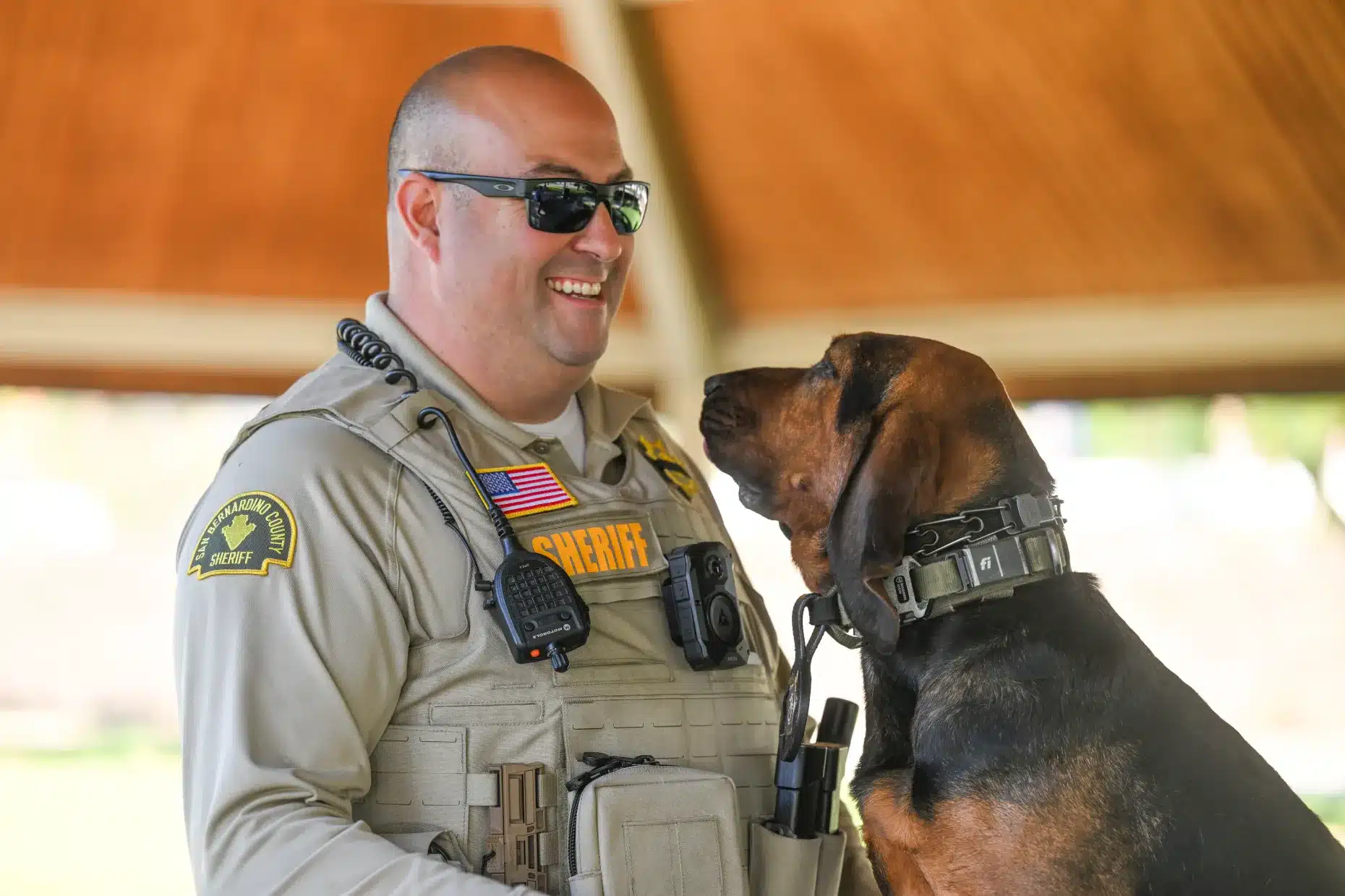
Keva, a San Bernardino County sheriff’s K-9, has a different job and works at a more deliberate, yet thorough, pace.
The bloodhound has tracked more than two dozen missing adults and children, including many with cognitive disabilities. Those happy outcomes are in addition to the arsonists, burglars and robbers who were out of sight but not out of reach of Keva’s smell.
Keva and handler Deputy Gabriel Jasso, 40, last year received an American Kennel Club’s Award for Canine Excellence.
“It’s her tenacity, just her willingness to work in any kind of conditions,” said Jasso, who has worked with the 4-year-old since she was months old. “She’s very focused when it’s time to work.”
Jasso picked her from among a group that looked about the same to him: “That one’s cute, that one’s cute,” he recalled thinking. But Keva stood out — “the most rambunctious.”
Bloodhounds have to zero in on one smell among many.
“They were bred for hunting,” Jasso explained. “So they know that whatever they smell (that is provided to them), that’s what they’re going to go look for.”
While some detection dogs alert their handlers by pointing with their noses or sitting, Keva is more demonstrative.
“She does a little dance on her front paws and her tail goes a million miles a minute,” Jasso said. “The tail doesn’t stop, and it’s her knowing that she’s going to get paid because she gets paid in food (usually a chicken-based treat).”
Jasso and Keva teamed up on what the deputy said was the most emotionally draining call of his career.
Jasso, whose daughter was 4 years old at the time, was called to find a girl who was 2 and had wandered off. Keva twice took him to a spot outside a pedestrian gate at the back of an apartment complex, where Jasso could hear coyotes in the nearby park.
“I’m like, ‘Oh my God, a girl got taken by the coyotes, because they’re out there yelping like they just got some prey,’ ” Jasso said. “And my heart dropped.”
Jasso knocked on the nearest door, and a man answered, the girl in his arms.
She had crawled through a small opening in a garage door and fallen asleep inside.
The nose knows
Criminals’ tactics constantly evolve. But the nose always knows.
San Bernardino County sheriff’s Sgt. Alex Collins says inmates try to sneak illegal drugs into jails every day.
“Our No. 1 problem is fentanyl,” he said.
Inmates mostly try to hide drugs on their bodies, including their rectums, with the No. 2 hiding spot the mail. Letters, even family photographs, come in coated with liquid drugs for the inmates.
“They’ll take a piece off and eat it,” Collins said.
So Rip, and other drug-detection dogs with the department, sniff away in the jails’ visiting rooms and cells.
Orange County Fire Authority Capt. Shaun Miller, an arson investigator, has a partner who can literally smell a crime, too.
Timber became one of only four accelerant-detection dogs in California when he replaced the retired Freedom in September 2025. The yellow Labrador can smell as little as one squeeze from an eyedropper of an ignitable liquid such as gasoline or lighter fluid.
To demonstrate at the agency’s Irvine headquarters, Miller, a 23-year department veteran, placed a drop of gasoline and various other flammable liquids in various parts of the courtyard, out of Timber’s eyesight. Timber sprinted to their spots and sat.
Miller rewarded Timber with a snack, asked him to point out the source of the odor with his nose, and when he did, he was again rewarded.
“Once that fire burns, there’s still stuff remaining,” Miller said. “They can find that remaining piece where a person walking through may not smell it.”
Miller recalled a fire that turned a vehicle into a mass of melted metal and plastic. Freedom kept alerting to the floorboard on the passenger’s side, but Miller couldn’t see anything.
Finally, Miller dug deep into the debris, finding a gas can.
“We’ve got a lot of cases like that,” Miller said.
When K-9s go wrong
Sometimes, however, the K-9s themselves are the danger. Like people, some are flawed, or their handlers are, or either makes a grave mistake.
In 2013, the Santa Ana City Council decided to pay $275,000 to a resident who said the year before he had been mauled by a police dog unleashed on him even though he wasn’t a suspect, prompting surgery on his right arm and elbow.
On Feb. 8, 2015, a Rialto police officer had just returned to his Hesperia home with his K-9, Jango, a Belgian Malinois. The officer put the dog in the backyard and went upstairs to change; the mom was at a store.
Jango for some reason attacked their 4-year-old son; the boy screamed and a man ran over and pried open Jango’s jaws and slipped one of the child’s legs out, but it had to be amputated.
‘That dog sacrificed’
Spike, a Burbank police dog who was shot to death in November 2025, was the latest K-9 to be killed in the line of duty nationwide, according to the Officer Down Memorial Page. The first was Vag, a K-9 for Buffalo, New York police, who died when he was struck by a streetcar on April 12, 1877.
With Spike’s death, the roll lists 591 fallen dogs.
On that list, too: Rudy, a Riverside County sheriff’s K-9 shot by a felon he was tracking and found in Perris in 2023, and Jack, a L.A. County sheriff’s dog shot in 2022 by a barricaded suspect he was attempting to capture in Gardena. And Bruno, a six-year veteran with the Anaheim Police Department, shot after finding a 21-year-old man in a trash bin and nosing open the lid; the man had already shot at probation officers before shooting the K-9. Bruno died two years later, in 2016 at age 10, of complications from his injuries.
In December 2025, hundreds of grieving police officers and firefighters with their dogs turned out for Spike’s memorial. He was shot to death by a suspect as he confronted him.
Pallbearers carried a tiny, flag-draped casket from a hearse and past saluting officers. Speakers offered tributes.
Corral had responded to the search for the gunman who later killed Spike. She saw Burbank’s officers that night.
“It was really hard to see the look on their faces, because they looked distraught,” Corral said.
Corral and Dart were at the memorial with other LAPD officers and handlers. They train with Burbank’s K-9 unit.
“We completely understand the struggle, the bond, and the danger,” Corral said. “Every call out. We know that call may be the last one for our dog. …
“Everybody should understand how that bond means the world, and that dog sacrificed,” she said of Spike. “That dog prevented cops from getting killed.”